
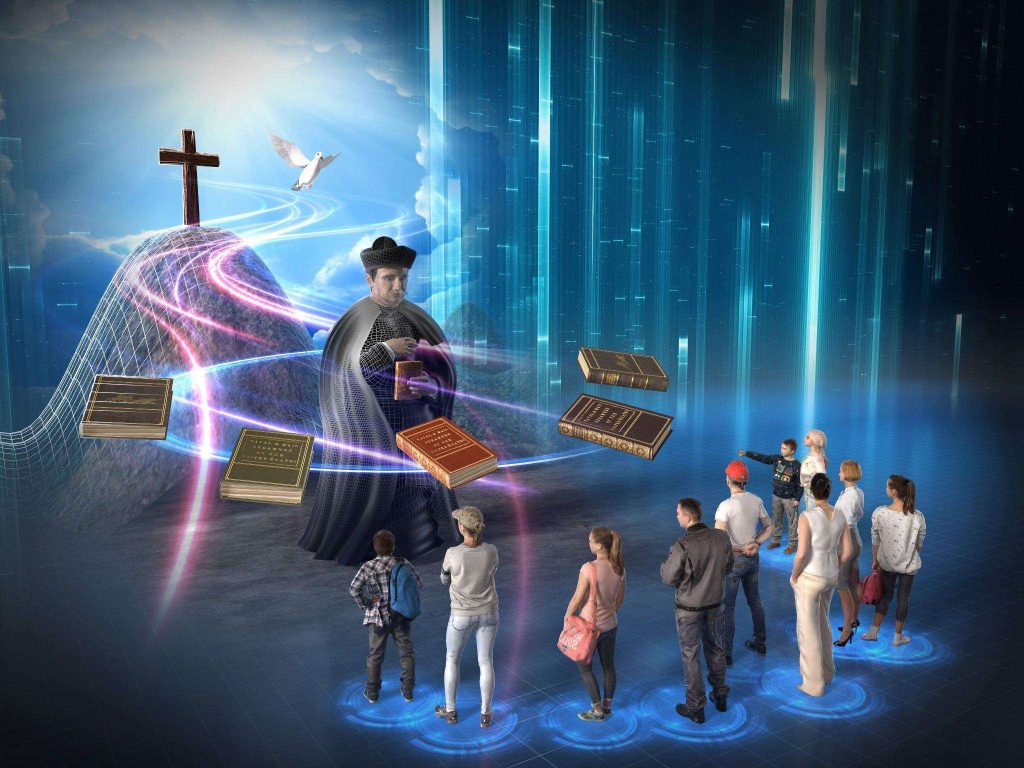
Development of Christian AI: Protestant Catechism-Bot
1. Background
A research and development group led by Prof. Seiji Kumagai (Professor of Kyoto University’s Research Institute for the Future of Human and Society, i.e., IFoHS) and Mr. Toshikazu Furuya (CEO of Teraverse Co., Ltd.) has previously developed numerous Buddhist AI products such as Buddhist chatbots and AR-s (Augmented Reality). Simultaneously, they have advanced multifaceted research and development activities with a view toward creating AI that inherits humanity’s intellectual heritage, including religions and philosophies from throughout history and across the globe.
Based on the above background, the R&D group from Kyoto University’s Kumagai’s Lab and Teraverse Co., Ltd. (Development Leader: Dr. Kunio Hase) has newly developed a Christian AI, called “Protestant Catechism-Bot.”
2. Training Data
“Catechism” is a Q&A-style summary of doctrine of Christian teachings. Catechisms have historically played a crucial role, used during introductory education (catechesis) and as a rite of passage before sacraments (such as baptism and confirmation). Thus, the Catechism as a doctrinal question-and-answer format is well-suited as learning data for chatbots and was adopted as the data to be learned by the AI.
The R&D group adopted Martin Luther’s (1483-1546) Small Catechism and the Westminster Shorter Catechism (1648) in addition to the New Testament as learning data.
3. Framework for the “Protestant Catechism Bot”
The framework for the Protestant Catechism-Bot system follows the framework of the Buddhist dialogue AI “BuddhaBot-Plus.” It employs a structure, where the AI selects the text from the New Testament, Luther’s Small Catechism, and the Westminster Shorter Catechism that it judges most relevant to the user’s question as the response. It then generates and provides interpretations or additional explanations based on OpenAI’s large-scale language database.
The Protestant Catechism-Bot can provide answers and advices based on the content of the New Testament and Catechism not only for questions about Christian teachings but also for everyday life.
4. The Significance of the “Protestant Catechism Bot”
Christianity is a minority religion in Japan (approximately 0.7% of Japan’s total population / approximately 30% of the world’s population). Through this Catechism-Bot, enabling many people to grasp the beginnings of an understanding of Christianity is considered beneficial in today’s increasingly globalized society. Even though the scope covered by the Protestant Catechism-Bot represents only a part of the Christian tradition, it will undoubtedly make a solid contribution to improving religious literacy.
5. Ethical Issues, Future Prospects, and Challenges of the Project
Generative AI systems like ChatGPT face numerous reliability issues, including unclear information sources, personal data leaks, and copyright infringement. Furthermore, previously unforeseen dangers have been pointed out in recent years, such as users becoming engrossed in conversations with generative AI and committing suicide. The Protestant Catechism-Bot addresses information source issues by machine learning from original texts and plans to implement countermeasures for other challenges sequentially and to the extent possible.
This product can be expected to be introduced to Christian mission schools and seminaries within Japan. Overseas, we also envision introducing it to English-speaking Christian communities if demand arises.
In the future, we plan to expand the learning materials to include a broader range of catechisms and confessional documents for clergy and educated individuals. These will encompass Protestant confessional writings such as Luther’s Large Catechism, the Augsburg Confession, the Heidelberg Catechism, and the Westminster Larger Catechism; ancient Christian creeds deeply associated with the Orthodox Church; and the Catechism of the Catholic Church.
Kyoto University’s Kumagai Lab and Teraverse Co., Ltd. plan to sequentially develop dialogue AI featuring philosophers and saints representing human history. This initiative aims to harmonize and advance cutting-edge technology with the human spirit, fulfilling both demand and supply, thereby opening up and recreating a rich tradition of knowledge within the digital space.
<Researcher’s Comments>
In addition to our existing Buddhist AI, the development of Christian AI has enabled us to achieve religious diversity in AI development. Moving forward, we intend to further accelerate the development of “Traditional Knowledge Tech” that integrates various religions and philosophies with technology, aiming to provide a richer digital culture.

